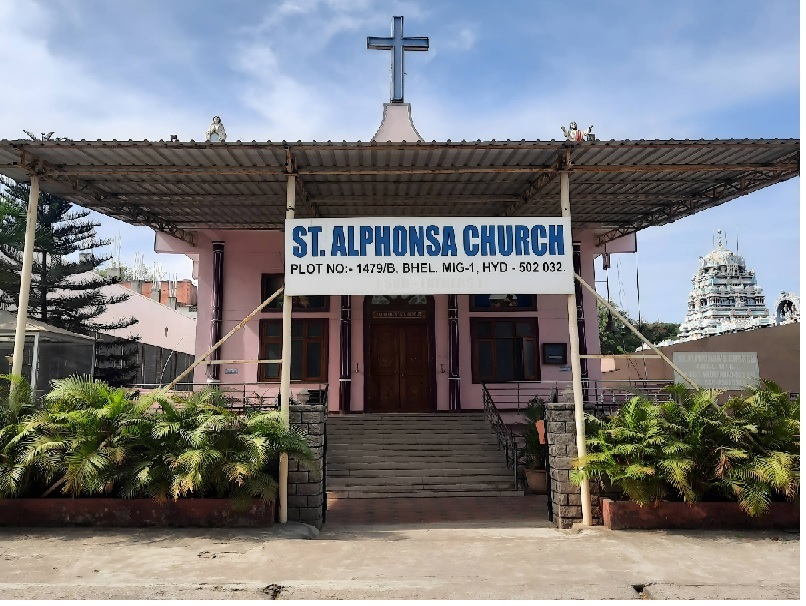
Postal Address:
St Alphonsa's church,
Plot no 1479/B, BHEL MIG Phase 1,
Hyderabad, Telangana 502032, India
Name
Role
Photo
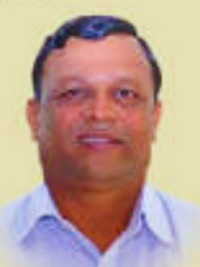
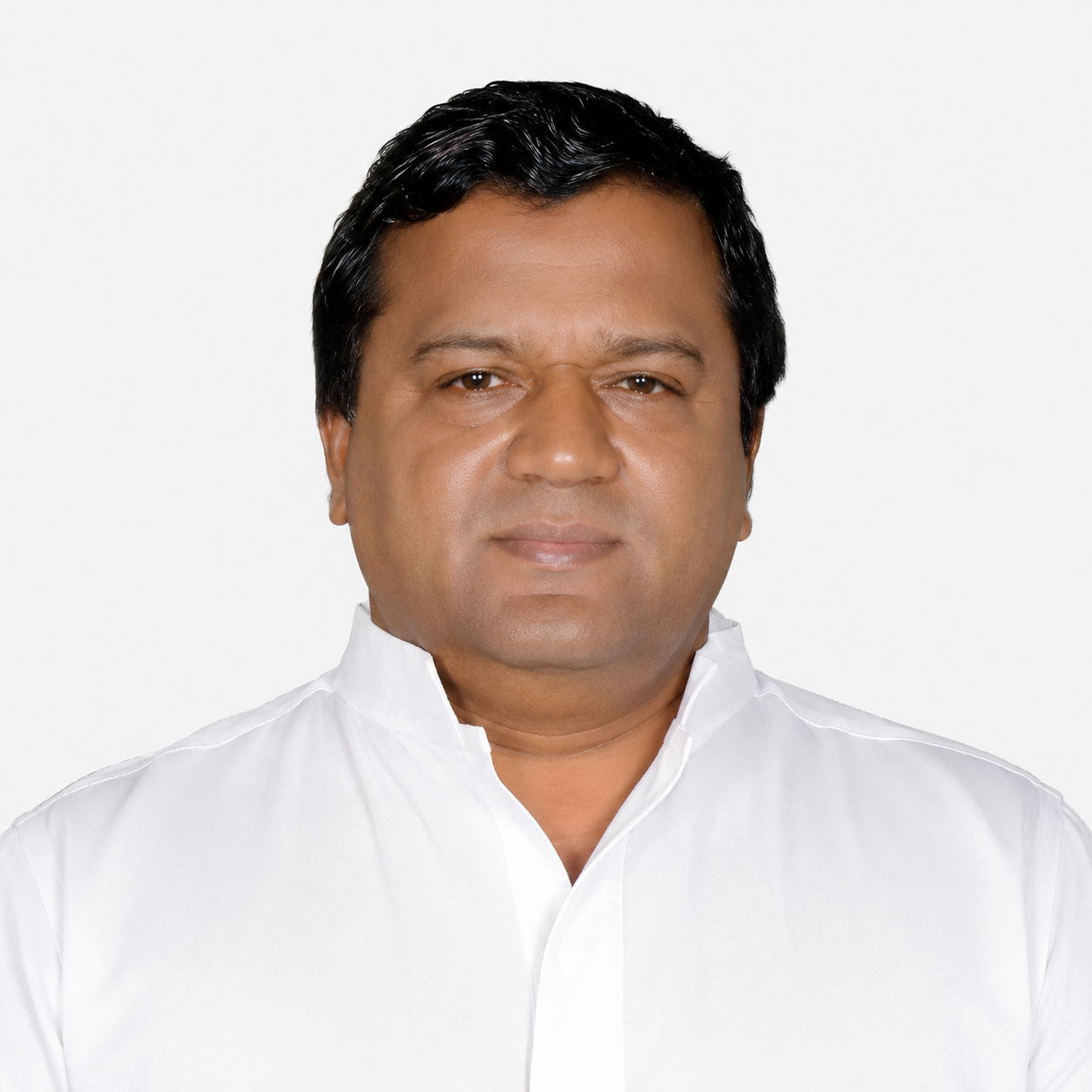
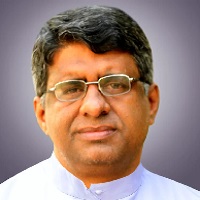
Fr C Bali Reddy
Parish Priest
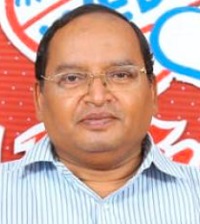
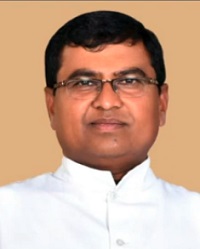
Fr Amala Nathan
Asst Parish Priest
Name
Year
Photo
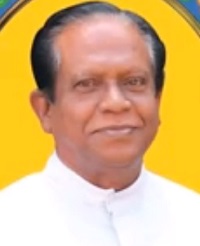
Fr S Devadass
2018-2025
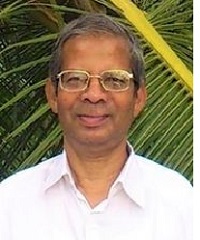
Fr Satish Kumar Banda
2015 - 2018
Fr P Varghese Chalamana
2013 - 2015 †08.10.2018
Fr P Wenceslaus
2012 - 2013 †10.10.2018
Fr K Pious Thomas
2011 - 2012
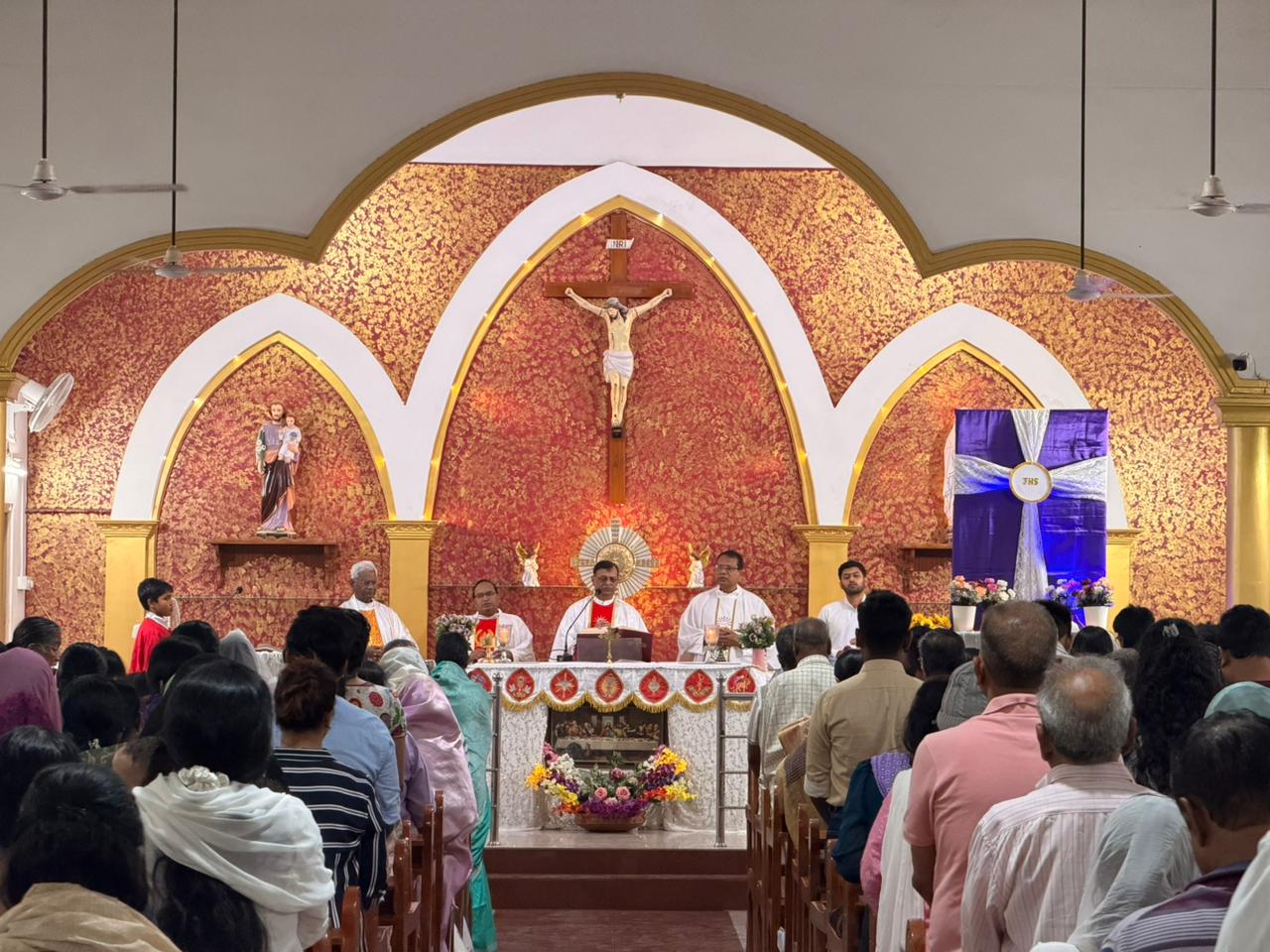
St. Alphonsa's Church BHEL serves the Catholic faithful in the Serilingampally area. The parish continues to grow through prayer, sacraments and community activities.
Brief History of BHEL Parish
It was a long cherished desire and dream of the Catholic employees of BHEL to have a place of worship in the vicinity. This desire dates back to the early 1960s, when Catholics gathered at the residence of Mr. Aloysius Pais (Quarter No. 66) to participate in the Eucharist and other spiritual activities, which were celebrated by Priests from Khairatabad, namely, Fr. Benny, Fr. Chinnappa and Fr. Johannes. About 100 people from BHEL and ALIND gathered for the services-a humble beginning indeed. Mr. Joseph, Stores officer Switch Gear Unit, BHEL, Mr. T.V. Cherian, Mr. Lourdu Swamy and Mr. J. Irudianath spared efforts in motivating the people. As numbers increased and with the allotment of St. Ann’s School to the Sisters of St. Ann of Providence in 1966, Holy Mass was celebrated in St. Ann’s School (SAP) campus.
A definitive change for good came in the early 1970s with the arrival of Fr. Joseph Puthumana SVD who took up the cause of procuring a place for the Church. In early 2003, the Catholic community along with other religious groups, represented to the BHEL, MIG Society for an allotment of land for the construction of a Catholic Church. As per the requirements of the MIG Society for the allotment of land, a society of the Catholic community was formed. Mr. J. Irudianath, Mr. Prince Baby, Mr. Thomas George, Mr. Bhagavanthudu, Mr. K.O. Devasia were the office bearers of the society. The Executive members were Mr. A. Abbai and Ms. K. Lucy. The Parish Priest of Ramachandrapuram was to be its Patron. The Society was registered under the name “Sneha Bandhu Society-A Catholic Welfare Society” vide No.1571 of 2003.
Subsequently the Managing Committee of MIG Society passed a resolution to allot land admeasuring 751 square yards to the Catholic community. Sneha Bandhu took possession of the land and developed it with the generous contribution of the members. Mr. Narsingh Rao, the then Chairman of Seri Lingampally Municipality and Mr. Janardhan Reddy MLA extended whole hearted cooperation in resolving the land allotment issue. Other religious communities namely, Hindus, Muslims and Protestants were also allotted land by the MIG Society to construct their own places of worship.
As soon as the land was allotted, Fr. Dominic Ekka SVD blessed it and erected a Cross on 22nd February, 2004. Novenas, prayer meetings and recitation of the Rosary especially during the months of May and October have been held ever since. The first Eucharistic celebration on the site was celebrated by Fr. Varghese Challamana SVD in 2004. A memorial service in honour of Pope John Paul II was also held on 08th April, 2005 by Fr. Ambrose SVD.
The Executive Body of Sneha Bandhu Society approached Archbishop Marampudi Joji seeking assistance for the construction of a Church on the allotted land. While complimenting the members for a “unique example of religious tolerance” Archbishop Marampudi Joji desired that the Church should be a spiritual centre for the faithful and should also cater to the social needs of the society. Thus the General Body of Sneha Bandhu Society met on 12th February, 2006 and ratified the decision of the Executive Committee Meeting which was held on 08th February, 2006 according to which Sneha Bandhu Society would hand over the land to the Archdiocese for the construction and smooth functioning of the place of worship and that the place of worship will be under the guidance of the Parish Priest of St. John’s Church, R.C. Puram. This Agreement of Understanding was drawn on 20th May, 2006.
The Managing Committee of the Church project under the Chairmanship of Fr. Dominic Ekka SVD, Parish Priest of R.C. Puram prepared a project proposal. But it was his successor, Fr. Pious Thomas SVD who keenly pursued the project. On 13th January, 2008 Archbishop Marampudi Joji visited the place and after the celebration of the Holy Eucharist, laid the foundation stone for the construction of the Church and also conducted a ‘ground-breaking’ ceremony. A large inter-religious and inter- denominational gathering witnessed the various ceremonies. On the same day i.e. 13th January, 2008 Archbishop Marampudi Joji declared that BHEL MIG Colony will be a “MISSION” and in due course of time may be raised to be a Quasi-Parish and later into a full fledged Parish. The tireless efforts of the Managing Committee of Sneha Bandhu Society and the Parish Council members of R.C. Puram were deeply appreciated.
The new Church was blessed and inaugurated on 19th January, 2010 by Msgr. Swarna Bernard in the presence of Fr. Jesu, the Provincial Superior of SVD Hyderabad Province and in the presence of many priests. Till 2010, that Church was a sub-station of St. John’s Church, R.C. Puram Parish. On 13th December, 2011, this Church was raised to the status of a Parish by Archbishop Thumma Bala and the Church was named after St.Alphonsa of Kerala. The first Parish Priest was Fr. Varghese Chalamana SVD, the second Parish Priest is Fr. Sathish Kumar SVD and the third Parish Priest is Fr. Devadass, SVD.
Men & Women Religious Congregations:
Society of The Divine Word (SVD) : Apart from the pastoral care of the above-mentioned Parish, the Society of the Divine Word Fathers also run St. Ann’s High School, Jyothi Vidyalaya High School, which belongs to BHEL and located in BHEL Township.
Ref: archdioceseofhyderabad.org
Arnold Janssen was born on November 5, 1837 in the town of Goch, Germany, a town near the Dutch border. From his childhood, he was influenced by the Prologue of St. John and developed a special love for the Word. He was ordained a diocesan priest in 1861, and began his ministry as a teacher. He began a magazine for mission awareness, The Little Messenger of the Sacred Heart. In the Messenger, he began to promote the idea of beginning a seminary to train diocesan priests for the missions. Because political conditions in Germany were unfavourable to Catholics, Fr. Janssen purchased land in nearby Holland to begin his seminary. On September 8, 1875 St. Michael the Archangel Mission House in Steyl, Holland was dedicated. The Society of the Divine Word was born.
Within a few years of its founding, scores of seminarians, priests and brothers were preparing for missionary service at Steyl and the first two missionaries were sent to China. One, Fr. Joseph Freinademetz, was an outstanding missionary who was beatified, along with St. Arnold Janssen, in 1975. In the late part of the 1800’s the Society of the Divine Word experienced tremendous growth and expansion. Mission Houses were opened in Austria and Germany, more mission areas were accepted by the Society.
Fr. Janssen founded two congregations of Sisters. December 8, 1889 marked the founding of the Holy Spirit Sisters, also known as “Blue Sisters”, due to the colour of their dress. The Sisters, carrying the charism of the Founder, began work in many of the areas where Divine Word Fathers and Brothers served, often building and operating schools and hospitals.
In 1896 Fr. Janssen also founded the Holy Spirit Adoration Sisters, also known as the “Pink Sisters”, a name taken from their pink habit. They spread all over the world, performing their ministry of prayer through perpetual adoration of the Eucharist.
Guiseppe (Joseph) Freinademetz was born on the 15th of April 1852 in Oies, a small hamlet of five houses situated in the Dolomite Alps of northern Italy. The region, known as “South Tyrol,” was then part of the Austro-Hungarian empire. He was baptised on the day he was born and inherited from his family a very simple but tenacious faith and a great capacity for work.
While Joseph was studying theology in the diocesan seminary of Bressanone (Brixen), he began to think seriously of the “foreign missions” as a way of life. He was ordained a priest on the 25th of July 1875, and assigned to the
community of Saint Martin (Martino di Badia) very near his own home, where he soon won the hearts of his countrymen. However, the call to missionary service did not leave. Only two years after ordination, he came into contact with Fr. Arnold Janssen, founder of a Mission House, which was soon to become known as the “Society of the Divine Word.”
With his Bishop’s permission, Joseph left for the Mission House in Steyl, Netherlands in August 1878. On the 2nd of March 1879, he received his mission cross and departed for China with Fr. John Baptist Anzer, another Divine Word Missionary priest. Five weeks later they arrived in Hong Kong, where they remained for two years, preparing themselves for the next step.
In 1881 they travelled to their new mission in South Shantung, a province with 12 million inhabitants and only 158 Christians.
At different times he served as Administrator for the Mission, Rector of the seminary, Spiritual Director for the first group of Chinese priests, and as Provincial Superior. He always exercised his authority in a brotherly fashion, and the respect he received came more from his example and life witness than from the dignity of the office he held.
His life was marked by a desire to become more like a Chinese among the Chinese and in that vein he wrote a letter to his family saying: “I love China and the Chinese; I want to die among them and be laid to rest among them”.
In 1898, Freinademetz was sick with laryngitis and had the beginnings of tuberculosis as a result of his heavy workload and many other hardships. Joseph decided to stay at the mission station at Puoli, knowing well the risk that he was taking. At the end of 1907, while he was serving as Diocesan Administrator for the sixth time, there was a severe outbreak of typhus. Joseph, like a good shepherd offering untiring assistance, visited the many communities until he himself became infected. He went to Taikia, seat of the diocese, where he died on the 28th of January 1908. He was buried at the twelfth station on the Way of the Cross and his grave soon became a site of pilgrimage point for Christians.
Freinademetz learned how to discover the greatness and beauty of Chinese culture and to love deeply the people to whom he had been sent. He dedicated his life to proclaiming the Gospel message of God’s love for all peoples, and to embodying this love in the formation of Chinese Christian communities. He animated these communities to open themselves in solidarity with the surrounding inhabitants. And he encouraged many of the Chinese Christians to be missionaries to their own people as catechists, religious, nuns and priests. His life was an expression of his motto: “The language that all people understand is that of love”.
The Society of the Divine Word began its mission in India in 1932 at Indore in Madhya pradesh. There are four Provinces and one Region in India. The INM (India Mumbai Province) consists of Kerala, Karnataka, Goa and Maharashtra, and INH (India Hyderabad Province) consists of Tamil Nadu and Andhra Pradesh. The INC (India Central Province) consists of Madya Pradesh, Gujarat, Rajasthan and Delhi, and Orissa, Bihar and Chattisgargh constitutes INE (India Eastern Province). ING (India Guwahati Region consists of Arunachal Pradesh, Assam, Meghalaya and Tripura. There are more than 800 SVD missionaries who are serving the Word all over the world. About 400 of these missionaries are doing marvellous missionary work abroad in more than 35 countries. Besides the minor seminaries in different states, we have our formation houses in Indore, Bhopal, Mysore, Chennai, Pune etc. There are about 600 seminarians in different formation houses.
Ref: svdmissioninm.com
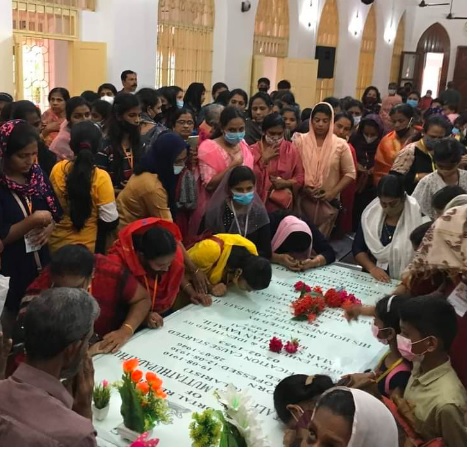
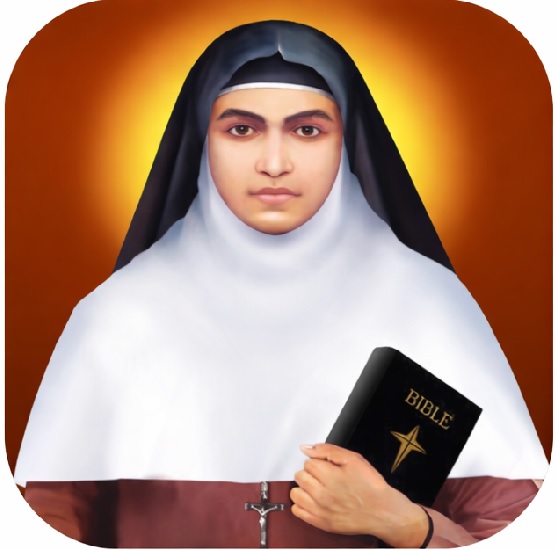
St. Alphonsa, India's First Female Saint was born as the fourth child of Joseph Muttathupadathu and Mary Puthukari. Both families claim to be the respected progeny of the ancient Syrian Christians of Malabar. Alphonsa belonged to the parish of Kudamalur, in the diocese of Changanacherry in the Travancore- Cochin State, the present Kerala State. Even her birth was shrouded in suffering. When her mother was eight months pregnant, because of the stifling heat, she was sleeping on the veranda. She was awakened by a snake that had entwined her waist. Instinctively she tore the serpent away from her. But she had the shock of her life which resulted in hastening the premature birth of the baby on 19th August, 1910. The mother died a few weeks after. The child was baptized ‘Anna’ on the 27th August at St. Mary’s church Kudamalur and was affectionately called ‘Annakutty’. The father and his mother nursed the child for some time. Then her mother’s sister, Annamma of Murickan family Muttuchira took her for further upbringing.
St. Alphonsa had been a victim of suffering throughout her life, she never voiced any complaint. She appeared like a beautiful Rose where only the beautiful flower is visible to the onlookers. But it grows on branches with thorns which are unnoticed by others. She was always found with a serene smile even though the thorns of agony were hidden inside, since she knew that God Almighty wanted her to endure this excruciating agony to make in her a grandeur of virtues. She never regretted her sufferings. She even prayed for more sufferings and God was pleased to grant her lofty enthusiasm. On Sunday, 28th July, 1946 her saintly soul flew silently to her Divine Maker, without any one standing around her deathbed being aware of it. The next day 29th July 1946, witnessed a funeral which was very simple. The coffin was carried in procession to the parish church by the sisters of the convent. At the Requiem Mass her special Spiritual Director gave the prophetic sermon. Her body was laid to rest in the tomb of the newly built cemetery chapel. It was providential that Alphonsa was buried at the very same spot where one finds her venerated tomb located today.
St. Alphonsa had a life span of only 36 years and she died on 28th July, 1946. At the funeral service, Rev. Fr. Romulus CMI, her spiritual director uttered:”With the most profound conviction in my heart I affirm that we are attending the last rites of a saintly person. If the world had realized her intrinsic worth, unprecedented crowds from all over India would have assembled here. I assure you that as far as human judgment can be relied upon, this young nun was not much less saintly than the Little Flower of Lisieux. Human languages are inadequate to explain divine and supernatural realities. Hence her greatness, spiritual charism and grace filled life needed a heavenly tongue and a heavenly messenger….The convent where she lived is blessed. Blessed are you sisters to have lived with her and to have served her. Bharananganam where her mortal remains will be interred is hallowed. If it is God’s Holy Will, this place will become the Lisieux of India.
St. Alphonsa, the first native woman saint of India, who lived as an unknown simple clarist nun within the four walls of the Franciscan Clarist convent at Bharananganam, in the state of Kerala, is now known all over the world. Her extraordinary power of intercession before her beloved Spouse Lord Jesus Christ, made her dear to everyone. Thousands of people from all walks of life irrespective of caste, creed, religion or country flow to the tomb of the saint to pray for their various needs and to pay homage and gratitude for the innumerable favours they received. St. Alphonsa stands as a challenge to the modern world who deplores their grief and miseries. She was meant by our good God to teach us in this pleasure intoxicated age this truth: ‘unless a grain of wheat fall to the ground and decay, it cannot bear any fruit’ and that ‘he who doth not carry his cross and follow our Crucified Master is not worthy of Him’
Annakutty received the veil of the Postulant on 2nd August, 1928 and she took the name ‘Alphonsa’ (to be precise ‘Sister Alphonsa of the Immaculate Conception’), after the Saint of the day St. Alphonsus Liguori. The Vestition was on 19th May, 1930 in a solemn occasion when she received the religious dress (Habit) from Mar James Kalacherry, the bishop of Changanacherry of that time. On that day, Sr. Alphonsa made a firm declaration: “I joined the convent to become a saint and having survived many obstacles, what have I to live for, if I don’t become a saint?” Sr. Alphonsa offered herself to Jesus as a victim of love. Her life was not one of roses, but that of sufferings – both physical and mental. A few months after her Vestition, she had an attack of haemorrhage for which she had to undergo an operation at Ernakulam. When her health improved a little, she spent one year at Vakakad as a teacher in the year 1932-’33. She entered Novitiate on 12th August, 1935. After one week of rigorous routine of Novitiate, Sr. Alphonsa developed a serious haemorrhage and a large ulcer on her leg which prevented her free movement. The superiors even thought of sending her back to Bharananganam. The bishop was consulted and after visiting her he decided that she should not be sent back. He preferred her death there, if it happens, rather than her being sent back.
Her condition remained crucial for a few months. At the suggestion of her Novice Master Rev. Fr. Louis CMI, a novena was started by the novices in common in honour of Bl. Kuriakose Elias Chavara. On the last day of the novena, Sr. Alphonsa had a vision of Bl. Kuriakose Elias Chavara who blessed her, touched her and said to her: “You are cured of this illness. And you won’t be affected by it again. But you will always have to bear up other sufferings.” Thus she was completely cured of her illness miraculously. On completing her Canonical Novitiate, she made her perpetual profession on 12th August, 1936. Sr. Alphonsa returned to Bharananganam and joyfully followed the Community life. But a few weeks later she had a severe attack of fever which lasted for six months. Tuberculosis was suspected. The whole community made novenas to Saint Little Flower and Bl. Kuriakose Elias Chavara. She was cured miraculously. When questioned insistently by the superiors, she confessed that a Carmelite nun came to her side, touched and healed her. She had a vision of Rev. Fr. Kuriakose Elias Chavara also.
Though Sr. Alphonsa got cured of the serious sickness, she was always tormented by minor ailments. She might probably have prayed for that because of her desire to identify herself with her Divine Groom. She appeared quite well during daytime but suffered greatly at night. Those were sleepless nights for her. When asked ‘what she was doing during such time of the night?’ her response was that she was loving. Having been miraculously healed Sr. Alphonsa got back to her regular life with others subjugating herself to all types of trials and hardships and emerging always victorious. Further afflictions began to appear one by one. She became seriously ill due to an attack of fever. Doctor diagnosed it as double pneumonia. Careful nursing and prayer by the community brought her back to health.
During this period a thief entered her room and she was seized with panic. As a result of this encounter with the thief, she suffered a serious mental breakdown and started behaving like a child. She lost her memory and even the capacity to read or write. But even in this abnormal state of her mind, she was in deep communion with the Lord either praying earnestly for others or seeking pardon for the sins of others. It took almost one year to get back to the normal stage after the great shock. No sooner had she recovered from her nervous breakdown than she was assailed with another affliction. There appeared a boil on her groin which slowly became an abscess causing unbearable pain. She was unable even to eat and her health deteriorated. Thinking that she has come to her last moments, the Last Rites were administered to her. But as foretold by Sr. Alphonsa, the crisis passed and on 30th September, the Death anniversary of St. Little Flower, she recouped her health.
Though Sr. Alphonsa had been a victim of suffering throughout her life, she never voiced any complaint. She appeared like a beautiful Rose where only the beautiful flower is visible to the onlookers. But it grows on branches with thorns which are unnoticed by others. She was always found with a serene smile even though the thorns of agony were hidden inside, since she knew that God Almighty wanted her to endure this excruciating agony to make in her a grandeur of virtues. She never regretted her sufferings. She even prayed for more sufferings and God was pleased to grant her lofty enthusiasm. In July 1945 Sr. Alphonsa had an attack of spasmodic pain which threw her into fits of violent convulsions. It began with prolonged vomiting and her body became quite cold as if frozen to the marrow. This leads to complete exhaustion and helplessness which lasts for three to seven hours. She was seen bathed in perspiration and seemed to grapple with death. This type of violent convulsions occurred frequently till her death. She was ready to suffer anything for the love of Jesus Christ. She prayed to God to transfer to her the Malaria of Sr. Thresia and the Bishop so that it may not affect their busy and important schedule. God was pleased to grant the prayer of His beloved. Very soon the Bishop and Sr. Thresia were found to be completely cured and Sr. Alphonsa had contracted Malaria!! The final phase of her agonies had persisted for over a year. She felt that it was time for her to join her beloved Spouse. She sought permission from Rev. Fr. Romulus and Mother Ursula to pray for her death.
On 16th July, 1946 Sr. Alphonsa wrote to the Mother General Rev. Sr. Bernerditta like this: ‘Even as the kite snatches off the chicken, so will the Lord snatch me away’. On Sunday, 28th July, 1946 her saintly soul flew silently to her Divine Maker, without any one standing around her deathbed being aware of it. The next day 29th July 1946, witnessed a funeral which was very simple. The coffin was carried in procession to the parish church by the sisters of the convent. At the Requiem Mass her special Spiritual Director gave the prophetic sermon. Her body was laid to rest in the tomb of the newly built cemetery chapel. It was providential that Alphonsa was buried at the very same spot where one finds her venerated tomb located today.
St. Alphonsa’s room was very near to the convent school and the students had developed a very close contact with her. They were inspired and motivated by the holiness of Sr. Alphonsa. Her life was very short as she died at the age of 36. From the very next day after the funeral, the school children went to her tomb to put flowers and lighting candles on her grave. They found their favours received. Soon the fragrance of her virtues and saintly life spread far and wide and many miracles happened through her intercession. God was pleased to honour and exalt this humble soul. On February 8th, 1986 Sr. Alphonsa was raised to the status of Blessed and on 12th October, 2008 she was canonized by H. H. Pope Benedict XVI. The striking aspects of her life were her childlike simplicity and her identification with the Crucified Christ. She had lofty esteem for the passion of Christ and was eager to fulfill in her body what was lacking in the affliction of Christ. She has held up before a questioning world, her conviction of the ultimate triumph of resignation to the Will of God and her tremendous faith in the redeeming value of suffering - physical and mental - endured on behalf of Christ. The keynote of her life was death to self and life to Christ and in Christ.
St. Alphonsa stands as a challenge to the modern world who deplores their grief and miseries. She was meant by our good God to teach us in this pleasure intoxicated age this truth: ‘unless a grain of wheat fall to the ground and decay, it cannot bear any fruit’ and that ‘he who doth not carry his cross and follow our Crucified Master is not worthy of Him’. God has sent St. Alphonsa, to show us that suffering is not only useful, but necessary. She considered suffering as a gift from God. She teaches us by her example that we must suffer not only for our own sins, but for the sins of others too, as we are all members of the same Body of Christ. As Christ suffered for us, we too must suffer for one another and thus make up for what is wanting in the sufferings of Christ, since Our Lord can suffer no more, we have to suffer. The secret of her holy life was that she carried on her ordinary duties in an extraordinary manner. Hers was the little way of St. Therese of Lisieux.
Taking into account the numerous miraculous cures happened through the intercession of St. Alphonsa, Mar Sebastian Vayalil, the bishop of Pala initiated the preliminary steps for her beatification and on 2nd December, 1953 H. E. Cardinal Tisserant formally inaugurated the process. After the long process of investigation, Sr. Alphonsa was beatified by H.H. Pope John Paul II along with Rev. Fr. Kuriakose Chavara CMI at Kottayam, Kerala. The Canonization of Bl. Alphonsa was on 12th October, 2008 by H. H. Pope Benedict XVI at Vatican. The Govt. of India has graciously honoured the first Indian Woman Saint by releasing a commemorative postal stamp worth Rs. 5/- on 16th November, 2008. The canonization of the saint was celebrated at Bharananganam on 9th November, 2008 in the valedictory function of which the chief guest was Dr. A. P. J. Abdul Kalam, our esteemed former president of India. 2010 is the birth centenary year of St. Alphonsa. The Centenary year was formally inaugurated on 23rd August, 2009 in a grand ceremony when Sri. Pranab Mukherjee, the Finance Minister was the chief guest. India’s highest esteem and recognition to the Saint was shown by releasing commemorative coins of Rs. 100/-and circulation coins worth Rs. 5/- on the occasion by honourable Minister for Finance, Sri Pranab Kumar Mukherjee.


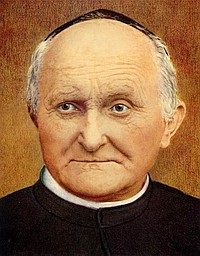 Arnold Janssen was born on November 5, 1837 in the town of Goch, Germany, a town near the Dutch border. From his childhood, he was influenced by the Prologue of St. John and developed a special love for the Word. He was ordained a diocesan priest in 1861, and began his ministry as a teacher. He began a magazine for mission awareness, The Little Messenger of the Sacred Heart. In the Messenger, he began to promote the idea of beginning a seminary to train diocesan priests for the missions. Because political conditions in Germany were unfavourable to Catholics, Fr. Janssen purchased land in nearby Holland to begin his seminary. On September 8, 1875 St. Michael the Archangel Mission House in Steyl, Holland was dedicated. The Society of the Divine Word was born.
Within a few years of its founding, scores of seminarians, priests and brothers were preparing for missionary service at Steyl and the first two missionaries were sent to China. One, Fr. Joseph Freinademetz, was an outstanding missionary who was beatified, along with St. Arnold Janssen, in 1975. In the late part of the 1800’s the Society of the Divine Word experienced tremendous growth and expansion. Mission Houses were opened in Austria and Germany, more mission areas were accepted by the Society.
Fr. Janssen founded two congregations of Sisters. December 8, 1889 marked the founding of the Holy Spirit Sisters, also known as “Blue Sisters”, due to the colour of their dress. The Sisters, carrying the charism of the Founder, began work in many of the areas where Divine Word Fathers and Brothers served, often building and operating schools and hospitals.
In 1896 Fr. Janssen also founded the Holy Spirit Adoration Sisters, also known as the “Pink Sisters”, a name taken from their pink habit. They spread all over the world, performing their ministry of prayer through perpetual adoration of the Eucharist.
Arnold Janssen was born on November 5, 1837 in the town of Goch, Germany, a town near the Dutch border. From his childhood, he was influenced by the Prologue of St. John and developed a special love for the Word. He was ordained a diocesan priest in 1861, and began his ministry as a teacher. He began a magazine for mission awareness, The Little Messenger of the Sacred Heart. In the Messenger, he began to promote the idea of beginning a seminary to train diocesan priests for the missions. Because political conditions in Germany were unfavourable to Catholics, Fr. Janssen purchased land in nearby Holland to begin his seminary. On September 8, 1875 St. Michael the Archangel Mission House in Steyl, Holland was dedicated. The Society of the Divine Word was born.
Within a few years of its founding, scores of seminarians, priests and brothers were preparing for missionary service at Steyl and the first two missionaries were sent to China. One, Fr. Joseph Freinademetz, was an outstanding missionary who was beatified, along with St. Arnold Janssen, in 1975. In the late part of the 1800’s the Society of the Divine Word experienced tremendous growth and expansion. Mission Houses were opened in Austria and Germany, more mission areas were accepted by the Society.
Fr. Janssen founded two congregations of Sisters. December 8, 1889 marked the founding of the Holy Spirit Sisters, also known as “Blue Sisters”, due to the colour of their dress. The Sisters, carrying the charism of the Founder, began work in many of the areas where Divine Word Fathers and Brothers served, often building and operating schools and hospitals.
In 1896 Fr. Janssen also founded the Holy Spirit Adoration Sisters, also known as the “Pink Sisters”, a name taken from their pink habit. They spread all over the world, performing their ministry of prayer through perpetual adoration of the Eucharist.
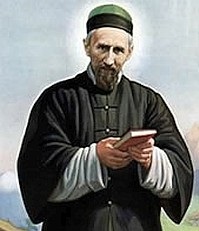 Guiseppe (Joseph) Freinademetz was born on the 15th of April 1852 in Oies, a small hamlet of five houses situated in the Dolomite Alps of northern Italy. The region, known as “South Tyrol,” was then part of the Austro-Hungarian empire. He was baptised on the day he was born and inherited from his family a very simple but tenacious faith and a great capacity for work.
While Joseph was studying theology in the diocesan seminary of Bressanone (Brixen), he began to think seriously of the “foreign missions” as a way of life. He was ordained a priest on the 25th of July 1875, and assigned to the
community of Saint Martin (Martino di Badia) very near his own home, where he soon won the hearts of his countrymen. However, the call to missionary service did not leave. Only two years after ordination, he came into contact with Fr. Arnold Janssen, founder of a Mission House, which was soon to become known as the “Society of the Divine Word.”
With his Bishop’s permission, Joseph left for the Mission House in Steyl, Netherlands in August 1878. On the 2nd of March 1879, he received his mission cross and departed for China with Fr. John Baptist Anzer, another Divine Word Missionary priest. Five weeks later they arrived in Hong Kong, where they remained for two years, preparing themselves for the next step.
Guiseppe (Joseph) Freinademetz was born on the 15th of April 1852 in Oies, a small hamlet of five houses situated in the Dolomite Alps of northern Italy. The region, known as “South Tyrol,” was then part of the Austro-Hungarian empire. He was baptised on the day he was born and inherited from his family a very simple but tenacious faith and a great capacity for work.
While Joseph was studying theology in the diocesan seminary of Bressanone (Brixen), he began to think seriously of the “foreign missions” as a way of life. He was ordained a priest on the 25th of July 1875, and assigned to the
community of Saint Martin (Martino di Badia) very near his own home, where he soon won the hearts of his countrymen. However, the call to missionary service did not leave. Only two years after ordination, he came into contact with Fr. Arnold Janssen, founder of a Mission House, which was soon to become known as the “Society of the Divine Word.”
With his Bishop’s permission, Joseph left for the Mission House in Steyl, Netherlands in August 1878. On the 2nd of March 1879, he received his mission cross and departed for China with Fr. John Baptist Anzer, another Divine Word Missionary priest. Five weeks later they arrived in Hong Kong, where they remained for two years, preparing themselves for the next step.
 St. Alphonsa, India's First Female Saint was born as the fourth child of Joseph Muttathupadathu and Mary Puthukari. Both families claim to be the respected progeny of the ancient Syrian Christians of Malabar. Alphonsa belonged to the parish of Kudamalur, in the diocese of Changanacherry in the Travancore- Cochin State, the present Kerala State. Even her birth was shrouded in suffering. When her mother was eight months pregnant, because of the stifling heat, she was sleeping on the veranda. She was awakened by a snake that had entwined her waist. Instinctively she tore the serpent away from her. But she had the shock of her life which resulted in hastening the premature birth of the baby on 19th August, 1910. The mother died a few weeks after. The child was baptized ‘Anna’ on the 27th August at St. Mary’s church Kudamalur and was affectionately called ‘Annakutty’. The father and his mother nursed the child for some time. Then her mother’s sister, Annamma of Murickan family Muttuchira took her for further upbringing.